
BIOFABRICATION TECHNOLOGIES
Biofabrication is at the heart of the MaldaLab. We develop and combine advanced manufacturing technologies, biomaterials and living cells to build functional tissue structures for regenerative medicine, disease modelling and sustainable living materials. Rather than relying on a single printing approach, our research focuses on the convergence of complementary biofabrication technologies to recreate the architecture, mechanics and biological complexity of native tissues.
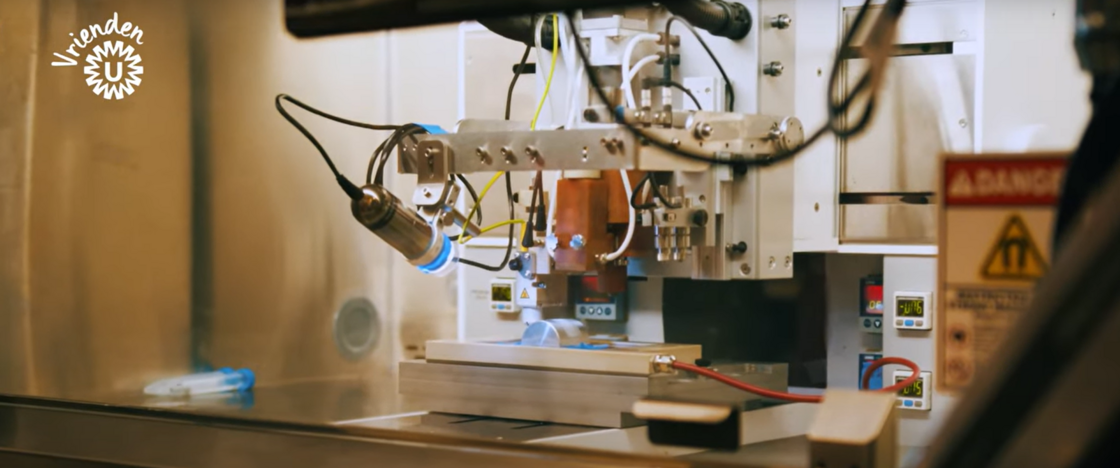
Within the Utrecht Biofabrication Facility, we work with a broad range of additive manufacturing and bioprinting platforms, including extrusion-based bioprinting, fused deposition modelling, digital light processing, volumetric bioprinting, solution electrospinning, melt electrospinning, melt electrowriting and laser-induced forward transfer. Each of these technologies offers specific advantages in resolution, speed, material compatibility or cellular precision. By integrating them, we create composite structures in which hydrogels, cells, microtissues, fibres and mineralised materials can be patterned across multiple length scales.
A major focus of our work is the development of reinforced living constructs. For load-bearing tissues such as cartilage, bone and the osteochondral unit, biological function is tightly linked to mechanical integrity and anisotropic architecture. We therefore design fibre-reinforced hydrogels, osteochondral scaffolds and microtissue-based constructs that combine cell-supportive bioinks with mechanically instructive frameworks. These technologies allow us to guide tissue formation, support long-term maturation and move towards grafts that can better withstand physiological loading.
Materials and bioink design

The success of biofabrication depends on materials that are printable, cell-compatible and functionally instructive. We develop and apply bioinks based on natural and synthetic hydrogels, extracellular matrix-derived components, dynamic crosslinking chemistries, ceramics and thermoplastic polymers. These materials are designed to support cell survival, differentiation, matrix deposition and tissue fusion, while also providing the mechanical and structural properties required for maturation and implantation.
Our material strategies include photo-crosslinkable and chemically crosslinkable hydrogels, cartilage- and tissue-derived extracellular matrix components, ceramic inks for bone regeneration and dynamic hydrogels that can support microtissue fusion. By tailoring stiffness, degradation, crosslinking and biochemical cues, we aim to create instructive microenvironments that allow cells and microtissues to organise into functional tissue-like structures.
These approaches connect directly to our broader ambitions in scalable tissue manufacturing. Through projects such as micro2MACRO and FAB4FUTURE, we aim to move from individual lab-scale constructs towards reproducible, automated and configurable production of living materials. This includes applications in regenerative medicine, in vitro models and other life-science domains where tissue architecture, function and manufacturability need to be engineered together.

Converging technologies, automation and AI

The next generation of biofabrication requires not only better materials and printers, but also smarter and more scalable production workflows. We are developing technologies for controlled patterning of cells, spheroids and organoids into larger constructs, with a particular focus on reliable, quantifiable and automated manufacturing. Recent work includes the integration of laser-induced forward transfer with melt electrowriting to position cartilage microtissues within reinforcing fibre meshes, supported by image analysis and AI-based process optimisation.
These approaches connect directly to our broader ambitions in scalable tissue manufacturing. Through projects such as micro2MACRO and FAB4FUTURE, we aim to move from individual lab-scale constructs towards reproducible, automated and configurable production of living materials. This includes applications in regenerative medicine, in vitro models and other life-science domains where tissue architecture, function and manufacturability need to be engineered together.